

AI agents are moving into production across enterprise software teams. But for most ISVs building them, there is still no clear path to getting them discovered, adopted, and purchased at scale.
Over the past year, the focus has largely been on building. Teams have shipped agents, tested use cases, and proven value. What hasn’t been as clear is how those agents get discovered, adopted, and turned into revenue.
Traditional SaaS distribution doesn’t fully solve this. It assumes users will find a product, evaluate it, and then start using it as a separate tool. That model doesn’t map cleanly to how AI agents are used.
Agents are not standalone products. They are used within workflows. They are invoked when needed, not accessed through a login.
That’s where things are starting to change.
With Agent-as-a-Service (AAS) listings on Google Cloud Marketplace, AI agents can now be packaged and made available directly within enterprise environments, including inside tools like Gemini.
This creates a more direct path from building an agent to getting it used.
What is this update about?
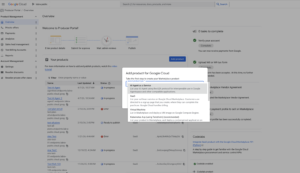
Labra now enables AI Agent-as-a-Service (AAS) listings on Google Cloud Marketplace, making it possible for ISVs to take AI agents beyond internal deployments and bring them into a structured, enterprise-ready distribution channel.
Until now, most teams building AI agents have had to rely on direct sales, custom integrations, or standalone deployments to get their products in front of customers. That approach does not scale easily and often slows down adoption.

With AAS listings, AI agents can now be packaged and offered as marketplace products. This means they can be:
- listed and made available through Google Cloud Marketplace
- deployed directly within enterprise environments
- and discovered within tools that teams already use, such as Gemini
Why do AI agents need a different distribution model?
Enterprise software distribution has been evolving for a while, but two shifts are now converging in a way that’s hard to ignore.
Cloud marketplaces have become a primary procurement channel. Many enterprises now prefer to buy through AWS, Azure, or Google Cloud, not just for convenience, but because it aligns with existing budgets, committed spend, and internal approval processes.
AI adoption has moved beyond experimentation. Teams are no longer just testing models. They are integrating AI into workflows across engineering, security, operations, and customer-facing functions.
What hasn’t fully caught up is how these AI capabilities are distributed.
Traditional SaaS distribution assumes a clear sequence:
- discover a product
- evaluate it
- purchase it
- and then use it as a standalone tool
And that model works when the product is something users log into and operate directly.
AI agents don’t behave that way. They are used within workflows, triggered by context, and often embedded into systems teams already rely on. As a result, the point of discovery shifts.
Instead of searching for tools externally, users are starting to encounter capabilities inside the environments where the work is already happening.
This changes how adoption happens. And therefore there is less separation between:
- discovery and usage
- evaluation and deployment
And when procurement is tied to cloud marketplaces, there is also less friction between:
- usage and purchase
This has direct revenue implications.
Marketplace-led motions have already shown:
- faster purchasing cycles, often reduced by up to 50%
- larger deal sizes, driven by alignment with committed cloud spend
- higher conversion rates, because evaluation and procurement are part of the same flow
AI agents fit naturally into this model because they are not just products to be bought, but capabilities to be used in context.
That is why their distribution needs to follow a different path.
What’s changed with AAS listings?
AAS listings are built on the same foundation as traditional SaaS listings, but a few critical differences set this new category apart.
1. What gets listed
Teams are no longer publishing software that users invoke. They’re registering AI agents as deployable services.
Teams are no longer publishing software that users invoke through an API. They’re registering AI agents as deployable services that get imported directly into the customer’s environment and interacted with from inside tools like Gemini.
2. The Agent Card
The Agent Card is a structured identity for the agent. It defines what the agent can do, how it interacts, what skills it has, and what authentication it requires. Without it, the marketplace has no way to understand, surface, or integrate the agent meaningfully into discovery experiences.
3. Deployability
With traditional SaaS listings, validation is mostly about configuration and integration. With AAS, the agent has to pass a deployability test. It needs to be imported into environments like Gemini and verified to actually work as expected. You can’t list it and figure out deployment later.
4. Discovery
Agents are not sitting on a static marketplace page waiting to be found. They’re surfaced inside AI-driven interfaces where users can find them and interact with them directly, without ever leaving the environment they’re already working in.
Taken together, these aren’t just updates to a listing format. They represent a fundamentally different way of packaging and distributing software.
What Labra Enables
Building an AI agent is one problem. Getting it into a state where it can be discovered, deployed, and purchased through a marketplace is a completely different one. and it’s where most teams lose time.
The requirements are specific. The agent needs to be structured in a way the marketplace understands, integrated with cloud environments, tested in a live deployment, and validated before it can go live. None of this is part of building the agent itself, but all of it has to be done before it ships.
Labra handles this layer end-to-end.
1. Structuring the listing
Labra sets up the agent as a marketplace product with the right metadata, categorization, and positioning so it surfaces correctly within Google Cloud Marketplace and AI-driven discovery experiences.
2. Defining the Agent Card
The Agent Card is the source of truth for how the marketplace understands your agent. Labra translates product capabilities into a structured definition that supports discovery, interaction, and integration correctly, the first time.
3. Managing integration requirements
IAM permissions, Pub/Sub connections, entitlement flows, pricing configuration – Labra handles the full set of marketplace-specific requirements that need to be in place before the listing can function as expected.
4. Validating deployability
AAS listings require the agent to be tested in a live environment, including being imported into Gemini and verified through actual interaction. Labra ensures the agent meets these requirements before submission, reducing the risk of failed reviews.
5. Orchestrating the path to publish
From initial setup to final approval, Labra manages the full sequence – validation, testing, and iteration based on marketplace feedback, so nothing falls through the cracks.
The result is a process that is repeatable and predictable. Teams spend less time navigating marketplace requirements and more time improving the agent itself.
💰How does this drive revenue
The shift to AAS listings is not just about how products are listed. It changes how revenue is generated and captured.
In a traditional motion, there are clear gaps between each stage. Discovery happens outside the product, evaluation takes time, procurement is handled separately, and only then does usage begin. Each of these steps introduces friction, and deals often slow down or drop off between stages.
AAS listings reduce that separation.
When an AI agent is discoverable inside environments like Gemini, it is surfaced at the point where a user already has intent. They are not searching for a vendor. They are trying to solve a problem, and the agent appears within that workflow.
This changes how evaluation happens.
Instead of scheduling demos or running separate trials, users can interact with the agent directly. The time between first exposure and actual usage becomes much shorter, which increases the likelihood of adoption.
Procurement also follows a different path.
Because the agent is listed on a cloud marketplace, the purchase can be routed through existing cloud budgets and committed spend. This removes a large part of the approval overhead that typically slows down deals, especially in enterprise environments.
There is also a trust layer built into this model.
Agents that are listed and validated through the marketplace, and tested in environments like Gemini, meet a baseline of technical and operational readiness. This reduces perceived risk for buyers and makes it easier to move forward.
Taken together, these changes compress the path from discovery to revenue.
Deals do not need to be pushed through each stage manually. They move forward because the steps are already connected.
This is why marketplace-led motions consistently show:
- Faster purchasing cycles, often reduced by up to 50%
- Larger deal sizes, driven by alignment with committed cloud spend
- Higher conversion, because evaluation and procurement happen closer together
For AI agents, this model is particularly effective.
Because they are used within workflows, the closer they are to the point of use, the easier it is to adopt them. And the easier they are to adopt, the more directly they contribute to revenue.
What this unlocks for ISVs
For ISVs building AI agents, the challenge is no longer just building something that works. It is figuring out how that agent reaches the right users, in the right context, without relying entirely on direct sales or custom deployments.
This is where AAS listings change the equation.
Instead of introducing the agent as a separate product that needs to be evaluated and integrated later, it can now be made available through a channel enterprises already use for both discovery and procurement.
That has a few practical implications.
Agents can be surfaced within environments where users are already working, rather than requiring them to look for external tools. This reduces the distance between a problem and a solution.
Adoption can scale through usage, not just sales effort. As more users interact with the agent in-context, it becomes easier to expand within accounts.
And because procurement is tied to the marketplace, teams are not building a separate path to close deals. They are working within an existing system that enterprises are already comfortable with.
Taken together, this introduces a more direct path from product to adoption.
The focus shifts from selling a standalone application to making a capability available where it can be used immediately.
A real-world example
Acalvio Technologies Preemptive Cyberdefense Agent is an early example of how this model works in practice.
The agent is now live on Google Cloud Marketplace and can be discovered directly within Gemini Enterprise.
This shows how an AI agent can move from being a standalone security product to something that is accessible within the environment where teams are already operating. Users can discover it, understand its value, and begin interacting with it without stepping outside their workflow.
That change in placement is what makes the distribution model more effective.
A new GTM motion is emerging
This is not an incremental change to how SaaS is sold.
It reflects a shift in how products are packaged and brought to market.
In this model:
- the product is an agent, not just an application
- distribution is handled through cloud marketplaces, not only direct sales
- discovery happens within AI-driven environments, not just through external search or outbound efforts
These changes are subtle on the surface, but they have a compounding effect.
When discovery, usage, and procurement are more closely connected, the path from product to revenue becomes shorter and more predictable.
As this model matures, the ability to package and distribute AI agents in this way will become a core part of how software companies operate.
If you are building AI agents and looking to reach enterprise customers through cloud marketplaces, this shift is already underway.
Labra helps teams move from building agents to making them marketplace-ready, handling the operational complexity required to list, validate, and deploy them in a structured way.
Get your AI agent in front of enterprise buyers on AWS, Azure, and GCP. Book a demo to see how!