

Cloud marketplaces aren’t a side channel anymore—they’re where enterprise buying happens.
And within that shift, Google Cloud Marketplace is proving to be a revenue accelerator for partners: a Futurum Group study of high-performing Google Cloud partners found 112% larger deal sizes through Marketplace, procurement cycles shortened by up to 4 weeks, and 70% of partners structuring multi-year deals tied to cloud commits.
The proactive support from Google Cloud representatives, combined with co-selling, really takes the partnership to the next level.
This blog breaks down what co-selling with Google Cloud Platform really means, how to maximize its benefits, and how Labra makes the entire process faster and frictionless.
What Is Co-selling With Google Cloud?
Co-selling is a coordinated go-to-market motion where your company and Google Cloud work together to win a customer — aligning on an account plan, sharing opportunities, and (often) transacting via Google Cloud Marketplace to streamline procurement.
Marketplace transacting lets customers apply their committed Google Cloud spend, making your solution both budget- and procurement-friendly.
For software vendors (ISVs), co-selling typically occurs within the Google Cloud Partner Advantage program and is often paired with a Marketplace listing to facilitate transactable offers and private deals.
What Are The Benefits?
- Faster deals, less friction: Buying through Google Cloud Marketplace removes vendor onboarding and leverages existing MSA and billing, which can materially compress cycle time.
- Access to Google’s field: Co-selling connects you with Google AEs, CEs, specialists, and PDMs who can open doors and align your solution to active cloud projects.
- Use of customer commits: Your buyers can often apply their pre-committed Google Cloud budget to your product when purchased via the Marketplace—an enormous lever for enterprise accounts.
- Higher retention and expansion potential: Google cites improved retention for ISVs selling via Marketplace, thanks to simplified renewals and multi-year structures.
- Co-marketing and program support: Mature co-sell motions unlock enablement, plays, and joint activities that raise your win rate.
How To Co-sell With Google Cloud
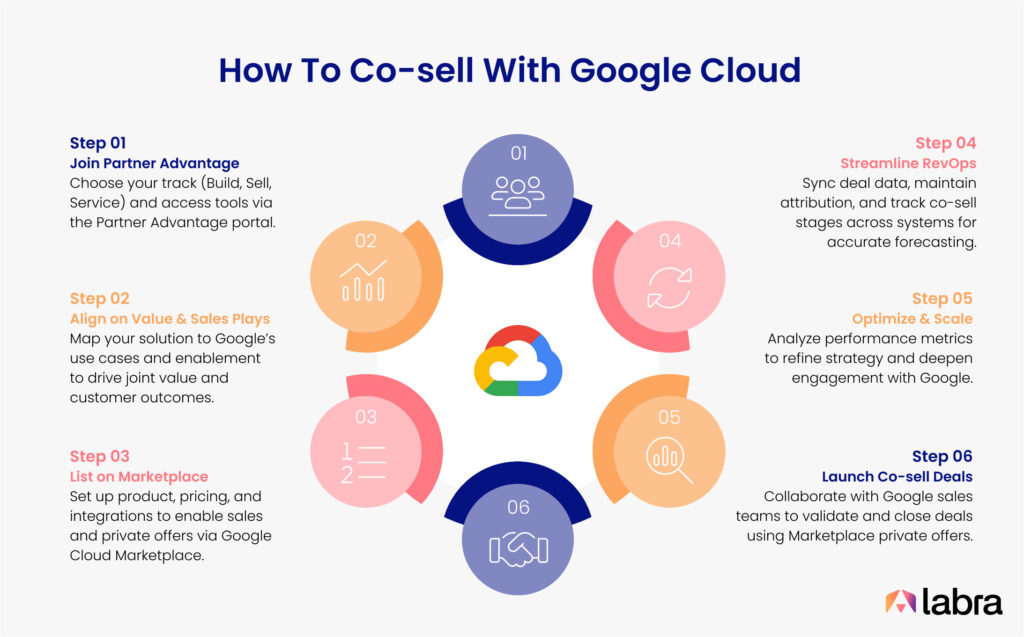
Step 1: Join Partner Advantage And Pick Your Track
If you build software to sell through Marketplace, you’ll operate in the Build track; services firms typically align to Service; resellers to Sell. Your Partner Advantage portal is the hub for enablement and program tools.
Step 2: List on Google Cloud Marketplace
Listing enables transactable deals, private offers, and commit drawdown. Expect product/pricing setup, integration work, and Google review before go-live. Many ISVs pursue ‘Build’ status before listing.
Step 3: Craft A Joint Value Narrative And Sales Plays
Map your ICP and use cases to Google’s sales plays and workloads (data/AI, app modernization, security, etc.). Enable Google’s field on why your solution accelerates consumption and customer outcomes.
Step 4: Work Your First Co-sell Opportunities
Coordinate with Google account teams (AE/FSR) and Customer Engineers (CEs) for technical validation. Use Marketplace private offers to tailor terms, pricing, and billing to the customer.
Step 5: Operate A Clean RevOps Process
Keep opportunity data synchronized with the partner portal, maintain attribution hygiene, track co-sell stages, and forecast Marketplace bookings alongside direct bookings.
Step 6: Measure, Learn, and Scale
Inspect win rates for Marketplace vs. direct, average sales cycle, commit-burn impact, and attach rates to Google workloads. Iterate on enablement and account mapping with your Google counterparts.
Teams Involved In Co-selling With Google Cloud
Co-sell wins are cross-functional by design. Here’s who usually shows up:
On your side (the ISV/SaaS team):
- Sales (AE/AM/SDR): builds the deal, aligns with Google AE, drives exec alignment.
- Alliances/Partnerships: owns the Google relationship, account mapping, and co-sell operations.
- Solutions/SEs: validates architecture, builds POVs, aligns to Google reference architectures.
- RevOps/Marketplace Ops: manages listings, private offers, reporting, and attribution.
- Marketing: co-marketing, customer stories, field events.
On Google’s side:
- Account Executive / Field Sales Rep: opportunity strategy and executive alignment.
- Partner Development Manager (PDM): orchestrates the co-sell motion with key partners and drives joint pipeline.
- Partner/ISV Engineers & Specialists: workload or industry specialists who help position and technically validate ISV solutions.
Tips to ensure success
- Lead with customer outcomes: Tie your offer to measurable improvements in a Google-aligned initiative (e.g., BigQuery cost/perf, Vertex AI time-to-value).
- Be commit-aware: Ask early about the customer’s Google Cloud commit and expiration. Marketplace transacting + private offers can be the difference in Q4.
- Run a single source of truth: Sync opportunities, stages, and contacts between your CRM and Partner Advantage to avoid mismatches and lost attribution.
- Celebrate wins (publicly and privately): Joint PRs and case studies feed the flywheel; internal win notes help Google teams pattern-match your best fits.
- Automate the plumbing: Manual uploads and spreadsheet tracking don’t scale. Tools like Labra remove administrative drag and reduce co-sell latency (more below).
Ready to streamline your Google Cloud co-sell motion? See how Labra makes it faster, cleaner, and more scalable. Book a demo with us.